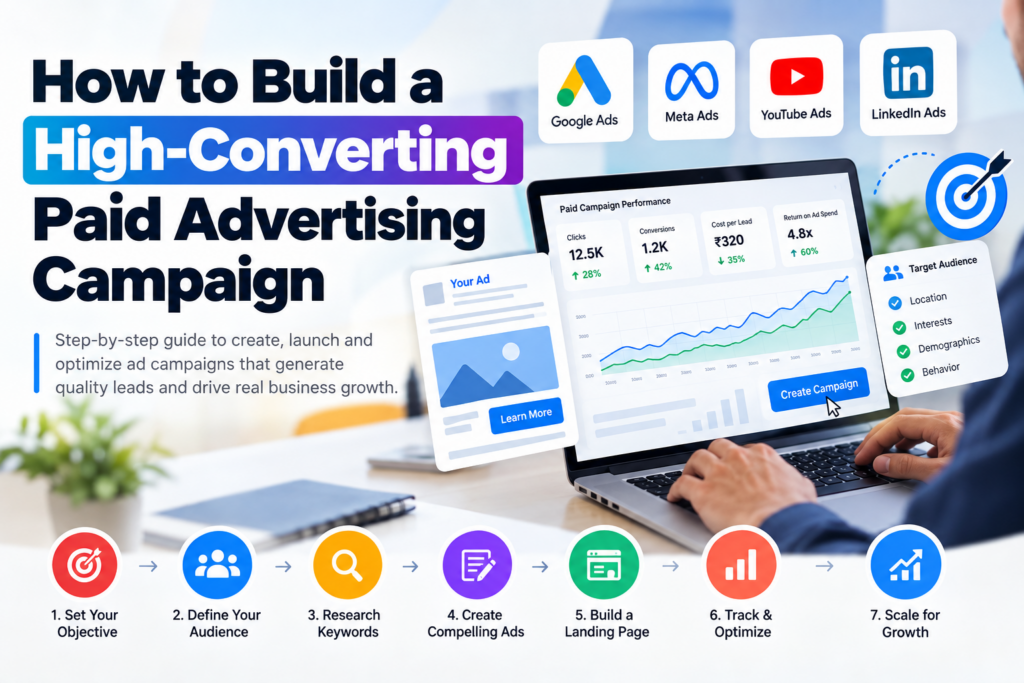
Paid advertising has become one of the fastest ways for businesses to reach potential customers, generate leads, increase website traffic, and drive sales. Platforms such as Google Ads, Meta Ads, YouTube Ads, and LinkedIn Ads allow businesses to reach people based on their interests, search behavior, demographics, location, and online activity.
However, simply running an advertisement does not guarantee results.
A successful paid advertising campaign requires the right combination of business objectives, audience targeting, keyword research, compelling ad copy, creative design, landing pages, conversion tracking, budget management, and continuous optimization.
In this guide, we will explain how to build a high-converting paid advertising campaign from the ground up.
What Is a Paid Advertising Campaign?
A paid advertising campaign is a marketing campaign where a business pays an advertising platform to display its advertisements to a selected audience.
Popular paid advertising platforms include:
- Google Ads
- Meta Ads
- YouTube Ads
- LinkedIn Ads
- Microsoft Advertising
- Other industry-specific advertising platforms
Businesses can use paid advertising to achieve different objectives such as:
- Generate leads
- Increase sales
- Drive website traffic
- Generate phone calls
- Increase app installations
- Promote products or services
- Build brand awareness
- Increase registrations or bookings
The most important factor is choosing a campaign objective that matches your actual business goal.
Why Is a Strategy Important for Paid Advertising?
Many businesses start paid advertising by creating an advertisement and immediately launching it.
This approach can lead to wasted advertising spend.
A proper strategy helps you answer important questions before launching a campaign:
- Who is your target customer?
- What problem are you solving?
- Which platform does your audience use?
- What keywords or interests should you target?
- What offer will you promote?
- What should users do after clicking the advertisement?
- How much can you afford to spend?
- How will you measure conversions?
- How will you optimize the campaign?
A well-planned campaign focuses on the entire customer journey rather than just the advertisement.
Step 1: Define Your Campaign Objective
The first step is to clearly define what you want your advertising campaign to achieve.
Different businesses may have different objectives.
For example:
A dental clinic may want appointment bookings.
An educational institute may want student enquiries.
An e-commerce business may want online purchases.
A real estate company may want property enquiries.
A digital marketing agency may want qualified business leads.
Your objective should be specific and measurable.
Instead of saying:
“I want more customers.”
Set a measurable objective such as:
“I want to generate 100 qualified leads per month.”
This makes it easier to measure campaign performance.
Step 2: Identify Your Target Audience
Understanding your target audience is one of the most important parts of paid advertising.
You need to understand who is most likely to purchase your product or service.
Consider factors such as:
Demographics
- Age
- Gender
- Location
- Language
- Occupation
- Income level
Interests
- Products they follow
- Services they need
- Topics they are interested in
- Brands they engage with
Behavior
- Previous website visits
- Search behavior
- Online purchases
- Engagement with advertisements
- Previous interactions with your business
Business-related factors
For B2B campaigns, consider:
- Industry
- Company size
- Job title
- Business location
- Decision-making role
- Business requirements
Creating an ideal customer profile can help you build more relevant campaigns.
Step 3: Understand Customer Intent
Not every person in your target audience is ready to buy.
Customers can be at different stages of the buying journey.
Awareness Stage
The customer is discovering a problem.
Example:
“How can I increase website traffic?”
Consideration Stage
The customer is researching solutions.
Example:
“Best SEO services for small businesses”
Decision Stage
The customer is ready to take action.
Example:
“SEO agency near me”
Your advertising strategy should consider these different levels of intent.
High-intent audiences can often be more valuable for lead-generation campaigns because they are closer to making a decision.
Step 4: Choose the Right Advertising Platform
Different platforms work better for different objectives.
Google Ads
Google Ads can be effective when people are actively searching for a product or service.
For example:
“Digital marketing agency in Hyderabad”
“SEO services near me”
“Google Ads agency Hyderabad”
Search advertising can capture existing demand because users are already searching for a solution.
Meta Ads
Meta advertising can be useful for:
- Brand awareness
- Lead generation
- E-commerce
- Remarketing
- Audience discovery
- Local businesses
Facebook and Instagram allow businesses to reach audiences based on various targeting signals and campaign objectives.
YouTube Ads
YouTube advertising can be useful for:
- Product demonstrations
- Brand awareness
- Educational businesses
- Video-based promotions
- Remarketing
LinkedIn Ads
LinkedIn can be particularly useful for B2B marketing where professional attributes are important.
The best platform depends on your audience, business model, product, sales cycle, and campaign objective.
Step 5: Conduct Keyword Research
For search advertising, keyword research is critical.
Your keywords should reflect what potential customers are actually searching for.
For example, a digital marketing agency might target keywords related to:
- Digital marketing agency
- SEO services
- Google Ads services
- Social media marketing services
- Performance marketing agency
However, do not select keywords simply because they have high search volume.
You should also consider:
- Search intent
- Competition
- Relevance
- Cost per click
- Commercial intent
- Expected conversion potential
The goal is not necessarily to get the highest number of clicks.
The goal is to attract relevant potential customers.
Step 6: Organize Your Campaign Structure
A well-organized campaign makes management and optimization easier.
For example, a digital marketing agency could organize campaigns around different services:
Campaign 1 – SEO Services
Ad Group:
- SEO services
- SEO agency
- SEO company
Campaign 2 – Google Ads Services
Ad Group:
- Google Ads agency
- PPC services
- Google Ads management
Campaign 3 – Social Media Marketing
Ad Group:
- Social media marketing
- Social media agency
- Social media management
This structure allows you to create advertisements that closely match the user’s search intent.
Step 7: Write Compelling Ad Copy
Your advertisement needs to communicate value quickly.
A strong advertisement should answer:
- What do you offer?
- Who is it for?
- What makes your offer valuable?
- Why should someone choose you?
- What action should they take?
For example:
Headline:
Grow Your Business With Digital Marketing
Description:
Get SEO, Google Ads, Social Media & Performance Marketing Solutions Designed to Generate Quality Leads.
Call to Action:
Get a Free Consultation
Your advertising copy should be relevant to the audience and aligned with the landing page.
Avoid making unrealistic claims simply to attract clicks.
Step 8: Create a Strong Offer
A good offer can significantly influence conversion rates.
Depending on your business, an offer could include:
- Free consultation
- Free website audit
- Free marketing analysis
- Free product demonstration
- Limited-time discount
- Free trial
- Consultation call
- Downloadable guide
- Special package
For example, instead of simply saying:
“We provide SEO services.”
You could offer:
“Get a Free SEO Website Audit.”
The offer gives potential customers a reason to take the next step.
Step 9: Create a High-Converting Landing Page
Getting someone to click your advertisement is only half the job.
The landing page needs to convince the visitor to take action.
A good landing page should have:
Clear headline
The headline should immediately communicate the value proposition.
Supporting information
Explain how your product or service solves the customer’s problem.
Benefits
Focus on customer benefits rather than simply listing features.
Social proof
Consider adding:
- Testimonials
- Reviews
- Case studies
- Client logos
- Results
- Certifications
Strong call-to-action
Examples include:
- Get a Free Consultation
- Request a Quote
- Book a Demo
- Contact Us
- Get Started
Simple lead form
Only ask for information that is genuinely necessary.
Long forms can discourage users from completing them.
Step 10: Make Your Landing Page Mobile-Friendly
A significant portion of online traffic comes from mobile devices.
Therefore, your landing page should work properly on:
- Smartphones
- Tablets
- Laptops
- Desktop computers
Check:
- Page loading speed
- Font size
- Button visibility
- Form usability
- Image size
- Navigation
- Content readability
A visitor should be able to understand the offer and take action without struggling.
Step 11: Set Up Conversion Tracking
Conversion tracking is essential for understanding whether your advertising campaign is actually working.
Depending on your business, conversions could include:
- Form submissions
- Phone calls
- WhatsApp enquiries
- Purchases
- Appointment bookings
- Demo registrations
- Downloads
- Sign-ups
Without proper conversion tracking, you may know how many people clicked your advertisement but not how many became customers.
For websites, businesses commonly use tools such as:
- Google Analytics
- Google Tag Manager
- Google Ads conversion tracking
- Meta Pixel
- CRM systems
Tracking should be configured before launching the campaign whenever possible.
Step 12: Set a Realistic Advertising Budget
Your advertising budget should be based on your business economics rather than an arbitrary number.
For example, consider:
- Average customer value
- Expected conversion rate
- Cost per lead
- Lead-to-customer conversion rate
- Profit margin
- Sales cycle
Suppose:
- Average customer value = ₹30,000
- Target cost per qualified lead = ₹1,500
- 10 qualified leads are required
Your initial advertising budget needs to be evaluated against the expected customer acquisition economics.
Do not increase your budget simply because impressions and clicks are increasing.
The key question is:
Are we generating profitable business from the advertising spend?
Step 13: Launch With Controlled Testing
Avoid making too many changes immediately after launching a campaign.
Start with a controlled setup.
Test variables such as:
- Different headlines
- Different descriptions
- Different images
- Different offers
- Different audiences
- Different landing pages
- Different calls-to-action
For example, you could test:
Version A:
Get More Leads With Digital Marketing
Version B:
Grow Your Business With Performance Marketing
The goal is to identify which message generates better-quality conversions.
Step 14: Monitor the Right Metrics
Do not judge a campaign only by clicks.
Important metrics include:
Impressions
How many times your advertisement was displayed.
Clicks
How many people clicked the advertisement.
Click-Through Rate (CTR)
The percentage of impressions that resulted in clicks.
Cost Per Click (CPC)
The average amount paid for each click.
Conversion Rate
The percentage of visitors who completed the desired action.
Cost Per Lead (CPL)
How much you spend to generate a lead.
Return on Ad Spend (ROAS)
The revenue generated relative to advertising expenditure.
Customer Acquisition Cost (CAC)
The overall cost associated with acquiring a customer.
The most important metrics depend on your campaign objective.
Step 15: Optimize Based on Data
Paid advertising is not a “set it and forget it” activity.
Campaign performance should be reviewed regularly.
Look for:
- High-cost keywords
- Low-quality leads
- Poor-performing advertisements
- Underperforming audiences
- High-performing locations
- High-converting devices
- Landing page issues
- Search terms that are irrelevant
- Conversion trends
Optimization should be based on actual data rather than assumptions.
Step 16: Use Negative Keywords Where Appropriate
For search advertising, negative keywords can help prevent advertisements from appearing for irrelevant searches.
For example, if you sell professional digital marketing services, searches containing terms such as:
“free digital marketing course”
may not be relevant if your campaign is targeting businesses looking for an agency.
Adding appropriate negative keywords can help reduce irrelevant clicks and protect your advertising budget.
Negative keyword strategies should be reviewed regularly because search behavior can change over time.
Step 17: Use Remarketing
Not everyone will convert during their first visit.
Some users may:
- Visit your website
- Read your service page
- Check your pricing
- Leave without contacting you
Remarketing can help you reconnect with eligible previous visitors or engaged audiences, depending on the advertising platform and applicable privacy requirements.
You can use remarketing to promote:
- Offers
- Products
- Services
- Webinars
- Consultations
- Special campaigns
Remarketing is particularly useful for businesses with longer decision-making processes.
Step 18: Improve Lead Quality, Not Just Lead Quantity
A common mistake is focusing only on the number of leads.
Suppose Campaign A generates:
100 leads at ₹500 per lead
But only 2 become customers.
Campaign B generates:
30 leads at ₹1,000 per lead
But 8 become customers.
Campaign B may actually be more valuable.
Therefore, evaluate:
Lead → Qualified Lead → Sales Opportunity → Customer
Your advertising campaign should ultimately contribute to business growth, not simply generate form submissions.
Step 19: Connect Advertising With Your Sales Process
Marketing and sales should work together.
When a lead comes in, consider:
- How quickly will you contact them?
- Who will follow up?
- How many follow-ups will be made?
- How will qualified leads be identified?
- How will sales outcomes be recorded?
A good advertising campaign can generate leads, but a strong follow-up process helps convert those leads into customers.
For service businesses, fast and consistent follow-up can make a significant difference.
Step 20: Scale Successful Campaigns Carefully
Once you identify a campaign, audience, keyword, advertisement, or offer that consistently performs well, you can consider scaling.
However, scaling should be controlled.
You can test:
- Higher budgets
- New audiences
- Additional locations
- New keywords
- Additional creative variations
- New landing pages
- Additional advertising platforms
Avoid making large changes without enough data.
The objective is sustainable growth rather than simply increasing advertising spend.
Common Paid Advertising Mistakes to Avoid
1. Targeting Everyone
Trying to reach everyone can waste your advertising budget.
Focus on your most relevant audience.
2. Using Broad Keywords Without Proper Control
Irrelevant searches can consume your budget.
Monitor search terms and refine targeting.
3. Sending All Traffic to the Homepage
A dedicated landing page can often provide a more relevant user experience.
4. Not Tracking Conversions
Without conversion tracking, it becomes difficult to understand campaign profitability.
5. Focusing Only on CTR
A high CTR does not necessarily mean you are generating quality customers.
6. Changing Campaigns Too Frequently
Constant changes can make it difficult to understand what is actually working.
7. Ignoring Mobile Users
A poor mobile experience can negatively affect conversions.
8. Failing to Follow Up With Leads
Generating a lead is only the beginning of the sales process.
9. Making Unrealistic Claims
Advertising should be clear, truthful, and aligned with the actual service or product.
10. Increasing Budget Without Checking Profitability
More spending does not automatically mean more profitable growth.
Paid Advertising Campaign Checklist
Before launching your campaign, check the following:
☐ Campaign objective is clearly defined
☐ Target audience is identified
☐ Location targeting is correct
☐ Keywords or audience targeting are relevant
☐ Campaign structure is organized
☐ Ad copy is compelling and relevant
☐ Offer is clearly communicated
☐ Landing page is ready
☐ Landing page is mobile-friendly
☐ Conversion tracking is configured
☐ Budget is defined
☐ Negative keywords are considered for search campaigns
☐ Remarketing strategy is considered where appropriate
☐ Lead follow-up process is ready
☐ Campaign performance metrics are defined
How Long Does It Take to See Results From Paid Advertising?
Paid advertising can generate traffic and potential conversions shortly after a campaign becomes active, but meaningful optimization generally requires enough data.
Results depend on several factors, including:
- Industry
- Competition
- Advertising platform
- Budget
- Target audience
- Offer
- Landing page
- Conversion rate
- Sales process
- Customer decision-making time
A campaign should therefore be evaluated using sufficient data rather than making decisions based on a very small number of clicks or conversions.
How Much Does a High-Converting Paid Advertising Campaign Cost?
There is no single advertising budget that works for every business.
Costs depend on:
- Industry
- Location
- Competition
- Keywords
- Audience
- Product or service price
- Customer lifetime value
- Conversion rate
- Campaign objective
Instead of asking only:
“How much should I spend?”
Businesses should also ask:
“How much can I afford to spend to acquire a profitable customer?”
This approach helps businesses create more sustainable advertising strategies.
Final Thoughts
Building a high-converting paid advertising campaign requires much more than creating an advertisement and setting a budget.
A successful campaign combines:
Clear goals + Target audience + Strong offer + Relevant targeting + Compelling ad copy + High-quality landing page + Conversion tracking + Continuous optimization
The objective should not simply be to generate more clicks. The real objective is to generate relevant traffic, qualified leads, customers, and measurable business growth.
Whether you are a small local business, e-commerce company, educational institute, healthcare provider, real estate business, service provider, or B2B company, a well-planned performance marketing strategy can help you reach the right audience and use your advertising budget more effectively.
Frequently Asked Questions
What is a high-converting paid advertising campaign?
A high-converting paid advertising campaign is a campaign designed to turn relevant advertising traffic into a desired action such as a lead, purchase, booking, registration, or enquiry.
Which platform is best for paid advertising?
There is no single best platform for every business. Google Ads can be valuable for capturing search demand, while Meta, YouTube, and LinkedIn can be useful for different audiences and objectives.
How can I reduce my cost per lead?
You can work on improving audience targeting, keyword relevance, advertisement quality, landing page experience, conversion tracking, and campaign optimization.
Should I use Google Ads or Meta Ads?
The right platform depends on your business, audience, product or service, customer journey, and campaign objective. In some cases, using both platforms can be appropriate.
Why is conversion tracking important?
Conversion tracking helps businesses understand which advertisements, keywords, audiences, and campaigns are generating meaningful actions rather than just clicks.
Can small businesses use paid advertising?
Yes. Small businesses can use paid advertising with controlled budgets and clearly defined objectives. The important factor is to monitor performance and focus on relevant customers rather than simply increasing advertising spend.
What makes a landing page important for paid advertising?
The landing page is where the visitor takes the desired action after clicking the advertisement. A relevant, fast, mobile-friendly landing page with a clear offer and call-to-action can support better conversion performance.
Conclusion
Paid advertising can become a powerful growth channel when it is treated as a complete marketing system rather than simply an advertising activity.
By understanding your audience, selecting the right platform, creating relevant advertisements, building effective landing pages, tracking conversions, and continuously optimizing based on data, your business can build a more efficient and scalable paid advertising strategy.